Introduction: The Real Question Is Not “Which Valve Is Better?”
When an industrial buyer compares a ball valve, gate valve, and globe valve, the real question is rarely “Which one is the best valve?” That question is too simple, and in industrial piping, simple questions often become expensive mistakes.
A better question is this:
Which valve fits the way your pipeline actually works?
If the system needs fast shut-off, low leakage risk, and easy operation, a ball valve is often the practical answer. If the valve will stay fully open or fully closed most of the time in a large pipeline, a gate valve may still make sense. If the pipeline requires frequent throttling or controlled flow adjustment, a globe valve is usually more suitable.
The problem is that many buyers select valves based only on price, size, or a previous project habit. That can lead to pressure loss, premature seat damage, leakage, poor flow control, difficult maintenance, or complete valve replacement after installation. In industries such as oil and gas, chemical processing, water treatment, power generation, shipbuilding, and hygienic systems, choosing the wrong valve is not just a small technical mismatch. It can affect operating safety, energy efficiency, downtime, and project cost.
This guide compares ball valves, gate valves, and globe valves from a buyer’s point of view. Instead of only explaining definitions, it focuses on real application scenarios, selection risks, common mistakes, and practical recommendations for overseas industrial buyers evaluating valve suppliers or planning pipeline projects.
What Is a Ball Valve?
A ball valve uses a rotating ball with a hole through the center to control flow. When the bore of the ball aligns with the pipeline, fluid passes through. When the ball rotates 90 degrees, the flow is blocked.
This quarter-turn design is the reason industrial ball valves are widely used for fast shut-off and reliable isolation. Compared with multi-turn valves, a ball valve is easier to operate, faster to open or close, and generally easier to automate with pneumatic or electric actuators.
For buyers who need reliable pipeline isolation, ball valves are commonly used in water systems, oil and gas pipelines, chemical processing lines, compressed air systems, fuel systems, HVAC systems, and many industrial utility lines.
A buyer looking for standard or customized options can review Vcore Valve’s ball valve product range to understand how different structures, materials, and connection types are used across industrial applications.
Main Advantages of Ball Valves
Ball valves offer quick operation, strong shut-off performance, compact structure, and low flow resistance. In full port designs, the internal bore is close to the same diameter as the pipeline, which helps reduce pressure drop and supports high-flow applications.
They are especially useful when the system requires on/off service rather than precise throttling. This is why ball valves are often selected for isolation points, emergency shut-off lines, utility systems, and process pipelines where reliable sealing matters more than fine flow adjustment.
Where Ball Valves Can Be Misused
A ball valve is not automatically the best choice for every pipeline. Standard ball valves are not ideal for continuous throttling unless specifically designed for control service. If a buyer uses a normal ball valve to partially open and regulate flow for long periods, the ball and seat may suffer erosion, vibration, or uneven wear.
Another common mistake is choosing the wrong port type. A reduced port ball valve may be suitable for many utility lines, but in high-flow systems or piggable pipelines, a full port ball valve may be required. Choosing the wrong bore size can increase pressure loss or restrict system performance.
What Is a Gate Valve?
A gate valve uses a gate or wedge that moves up and down to open or close the pipeline. When fully open, the gate is lifted out of the flow path, allowing fluid to pass through with very low resistance. When closed, the gate lowers to block the flow.
Gate valves are commonly used in large-diameter pipelines, water distribution systems, wastewater systems, fire protection lines, oil and gas transmission, and other applications where the valve normally stays fully open or fully closed.
The key point is that gate valves are designed for isolation, not regulation.
Main Advantages of Gate Valves
Gate valves perform well in systems that require a straight-through flow path and minimal obstruction when fully open. They are often preferred in larger pipelines where pressure drop must remain low and frequent operation is not required.
Because the gate moves gradually, the valve is slower to operate than a ball valve. In some systems, slow operation can reduce sudden flow shock, but in emergency shut-off applications, slow closing may be a disadvantage.
Where Gate Valves Can Be Misused
One of the biggest mistakes buyers make is using a gate valve for throttling. A partially open gate valve can create vibration, turbulence, disc damage, seat wear, and unstable flow. Over time, this can cause poor sealing or operational failure.
Another issue is installation space. Gate valves usually require more vertical clearance because the stem and gate move upward during operation. In tight mechanical rooms or compact skid systems, this can be a practical limitation.
What Is a Globe Valve?
A globe valve uses a movable disc and a stationary seat to regulate flow. Unlike a gate valve, the internal flow path changes direction inside the valve body. This design creates higher pressure drop, but it gives the valve better throttling performance.
Globe valves are commonly used in steam lines, cooling water systems, fuel oil systems, process control lines, bypass lines, and applications where flow needs to be adjusted rather than simply turned on or off.
Main Advantages of Globe Valves
The biggest advantage of a globe valve is control. It can regulate flow more precisely than a ball valve or gate valve. For systems where operators need to adjust flow rate, pressure, or temperature, a globe valve may be the safer and more accurate choice.
Globe valves also generally provide good shut-off capability, although they are usually not as fast to operate as ball valves and may create more pressure loss.
Where Globe Valves Can Be Misused
A globe valve is not the best choice if the main goal is low pressure drop and full-flow isolation. Because the internal flow path is more restrictive, using a globe valve in the wrong position can increase pumping energy, reduce system efficiency, and create unnecessary operating cost.
For large-diameter pipelines, globe valves may also be heavier, more expensive, and less practical than ball valves or gate valves.
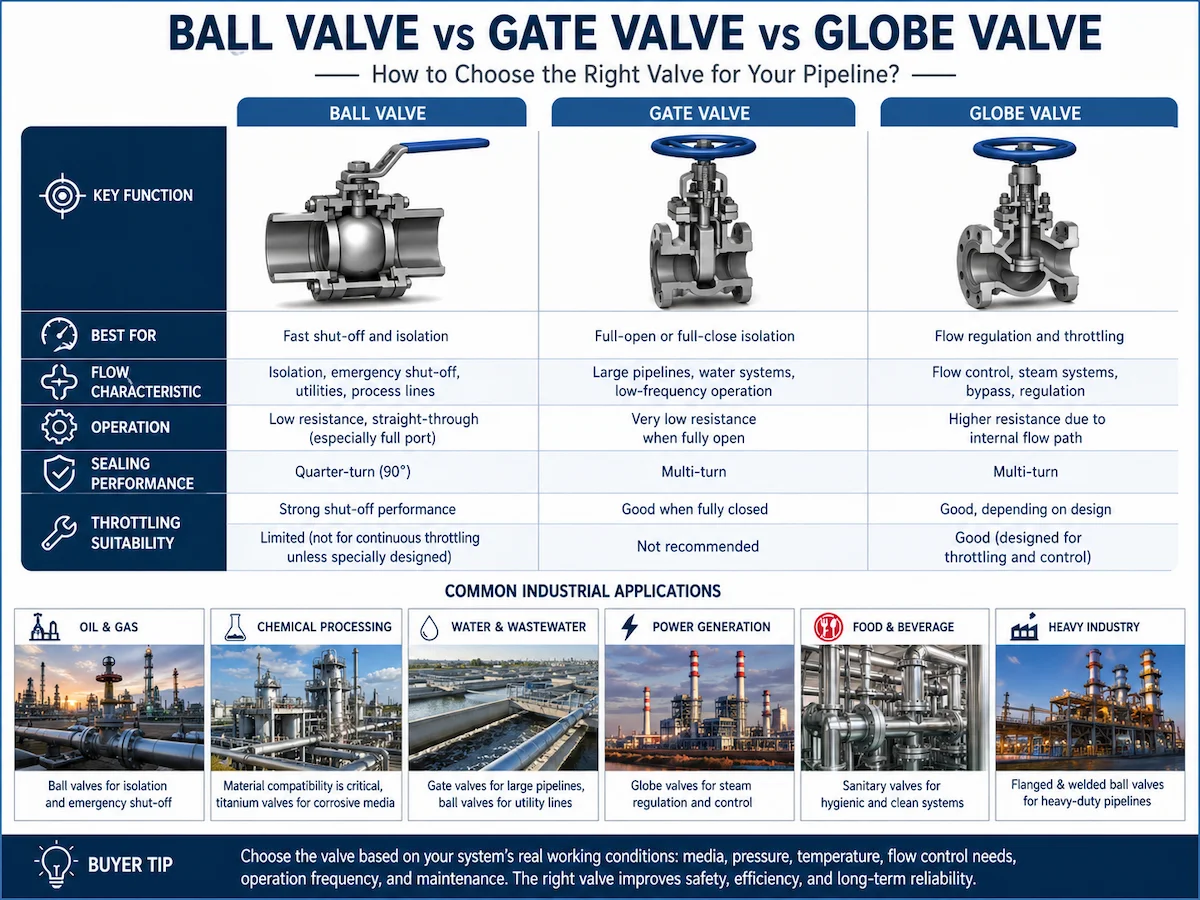
Ball Valve vs Gate Valve vs Globe Valve: Key Differences
The table below gives buyers a practical comparison. It is not just about valve names. It shows how each valve behaves inside a real pipeline.
| Selection Factor | Ball Valve | Gate Valve | Globe Valve |
|---|---|---|---|
| Best Function | Fast shut-off and pipeline isolation | Full-open or full-close isolation | Flow regulation and throttling |
| Operation Type | Quarter-turn | Multi-turn | Multi-turn |
| Opening / Closing Speed | Fast | Slow | Moderate |
| Flow Resistance | Low, especially full port design | Very low when fully open | Higher due to internal flow path |
| Throttling Suitability | Limited for standard designs | Not recommended | Good |
| Sealing Performance | Strong shut-off performance | Good when fully closed | Good, depending on design |
| Maintenance Demand | Generally low | Moderate | Moderate to high |
| Space Requirement | Compact | Requires more vertical space | Moderate |
| Automation Suitability | Very suitable | Possible but slower | Possible for control systems |
| Typical Use | Isolation, emergency shut-off, utilities, process lines | Water, wastewater, large pipelines | Steam, regulation, bypass, control lines |
| Common Buyer Mistake | Using standard design for throttling | Using it partially open | Using it where pressure loss must stay low |
Which Valve Makes More Sense for Your Pipeline?
In real procurement discussions, buyers do not usually say, “Please provide the theoretically best valve.” They ask questions like:
“Will this valve reduce flow?”
“Can it shut off quickly?”
“Can it handle chemicals?”
“Will it last in this pressure and temperature range?”
“Will maintenance become painful later?”
“Can we automate it?”
That is the right way to think.
If your pipeline needs quick shut-off and the valve will mostly stay fully open or fully closed, a ball valve is usually the first option to evaluate. It is compact, fast, and suitable for many industrial isolation duties.
If your pipeline is large and the valve will rarely operate, a gate valve may still be practical. For example, municipal water lines, fire protection systems, and some utility pipelines often use gate valves because they provide low resistance when fully open.
If your system needs flow adjustment, pressure balancing, or throttling, a globe valve is usually the more responsible choice. It may create more pressure drop, but it gives better control.
The buyer mistake is choosing only by valve size. Two valves with the same nominal diameter may behave very differently once installed. Internal bore, seat design, stem structure, pressure rating, sealing material, body material, connection type, and media compatibility all matter.
For general industrial isolation, Vcore Valve’s floating ball valve is a practical example of how ball valve design can support reliable shut-off in pipeline systems where compact structure and dependable sealing are important.
Application Scenarios: Where Each Valve Works Best
Oil and Gas Pipelines
In oil and gas systems, shut-off reliability is critical. Ball valves are widely used for isolation, emergency shut-off, fuel gas systems, and pipeline sections where fast operation is required.
For critical isolation points, especially where maintenance safety matters, a double block and bleed valve may be used to provide a higher level of isolation and pressure release capability. This type of valve is commonly considered when buyers need safer maintenance procedures in demanding pipeline systems.
Gate valves may still be used in larger pipeline systems where full-open service and low pressure drop are priorities. Globe valves are more suitable for control or regulation points, not primary isolation.
Chemical Processing
Chemical plants often require careful material selection. A ball valve may be selected for shut-off service, but the body material, seat material, seal material, and corrosion resistance must match the media.
For aggressive or corrosive environments, a titanium ball valve may be more suitable than a standard stainless steel or carbon steel valve. This is especially relevant in chemical processing, seawater systems, chloride-rich media, and other corrosion-sensitive applications.
The wrong material can cause corrosion, leakage, contamination, or unexpected shutdown. In chemical systems, the valve type matters, but material compatibility matters even more.
Water and Wastewater Treatment
Gate valves are common in water and wastewater systems because they work well for large-diameter isolation and full-flow service. However, ball valves are also widely used in smaller-diameter lines, dosing systems, utility lines, and areas requiring fast shut-off.
Globe valves may be used where flow control is needed, but they are not always the most energy-efficient option if the system requires high flow with low pressure drop.
Power Generation and Steam Systems
Steam and power systems often involve high temperature, pressure fluctuation, and control requirements. Globe valves are frequently used for throttling and regulation because they can control flow more accurately.
Ball valves may be used for isolation duties, but buyers must confirm pressure class, temperature resistance, seat material, and sealing structure. A standard soft-seated ball valve may not be suitable for every high-temperature system.
Food, Beverage, and Hygienic Systems
In hygienic systems, cleanability and contamination control are critical. Valve design must support smooth surfaces, sanitary connections, and easy cleaning.
For hygienic processing lines, a sanitary valve may be more appropriate than a standard industrial valve. Buyers in food, beverage, pharmaceutical, and biotech industries should evaluate not only valve function but also hygienic design, surface finish, cleaning requirements, and regulatory expectations.
Heavy-Duty Industrial Pipelines
For heavy-duty pipelines, connection strength and long-term sealing performance matter. A flanged welded ball valve may be considered where buyers need robust pipeline connection, stable sealing, and industrial-grade performance.
In these systems, buyers should evaluate pressure class, flange standard, welding quality, body material, testing standard, and inspection documentation before placing bulk orders.
Common Buyer Mistakes and Their Consequences
Mistake 1: Using a Gate Valve for Flow Regulation
This is one of the most common and damaging mistakes. A gate valve is designed to be fully open or fully closed. When used partially open, it may experience vibration, gate damage, seat wear, and unstable flow.
The consequence is often poor sealing, shortened service life, and higher maintenance cost.
Mistake 2: Choosing a Ball Valve Without Checking Port Type
A reduced port ball valve may be more compact and economical, but it restricts flow more than a full port design. If the system requires maximum flow capacity or pigging, a reduced port design may cause performance problems.
The consequence can include pressure drop, lower flow rate, and process inefficiency.
Mistake 3: Selecting a Globe Valve Where Low Pressure Drop Is Critical
A globe valve is excellent for regulation, but its internal path creates more resistance. If installed in a high-flow line where throttling is not needed, it may waste pumping energy and reduce efficiency.
The consequence is long-term operating cost, not just initial valve cost.
Mistake 4: Ignoring Media Compatibility
Valve material must match the fluid. Water, steam, oil, gas, acids, alkalis, seawater, slurry, and sanitary media all have different requirements.
The consequence of poor material selection can be corrosion, seat failure, leakage, contamination, and unplanned shutdown.
Mistake 5: Buying by Unit Price Only
A low-cost valve can become expensive if it fails early, causes downtime, or requires replacement after installation. Industrial buyers should compare not only purchase price but also service life, maintenance difficulty, sealing performance, test documentation, and supplier support.
This is where working with a professional industrial valve solutions provider becomes more valuable than simply comparing catalog prices.
Technical Comparison: Performance Factors Buyers Should Check
| Technical Factor | Why It Matters | Best Valve Fit |
|---|---|---|
| Fast shut-off | Reduces response time in isolation or emergency use | Ball valve |
| Low pressure drop | Helps maintain flow efficiency | Full port ball valve or gate valve |
| Frequent throttling | Requires stable control and seat durability | Globe valve |
| Large-diameter full-flow pipeline | Needs low resistance and full-open service | Gate valve |
| Compact installation space | Useful in skids, equipment packages, and tight pipelines | Ball valve |
| Corrosive media | Requires compatible body and sealing materials | Material-specific ball valve or globe valve |
| Hygienic processing | Requires cleanable design and sanitary standards | Sanitary valve |
| Critical isolation | May require double isolation and bleed function | DBB valve |
| Automation | Requires easy actuator operation | Ball valve or control globe valve |
Market Trend: Why Ball Valves Are Becoming More Popular in Industrial Projects
Ball valves are increasingly popular because many industrial systems now require faster operation, compact design, better automation compatibility, and reliable shut-off performance. Modern factories, modular process skids, oil and gas systems, chemical plants, and water treatment facilities often prefer valves that are easy to operate and integrate into automated systems.
Quarter-turn operation makes ball valves especially suitable for actuator installation. Compared with slower multi-turn valves, ball valves can simplify automated shut-off control and improve response time.
Another trend is material specialization. Buyers are no longer choosing only standard carbon steel or stainless steel valves. They increasingly evaluate titanium, duplex stainless steel, special alloys, PTFE seats, metal seats, anti-static design, fire-safe design, and low-emission sealing options depending on project requirements.
This does not mean ball valves replace gate valves or globe valves everywhere. It means ball valves are becoming a stronger default option for many shut-off and isolation applications, especially where speed, sealing, compactness, and automation matter.
How to Evaluate a Ball Valve Supplier
Selecting the right valve type is only half the job. The other half is selecting the right supplier.
A professional ball valve supplier should provide more than a product list. Buyers should look for engineering support, material selection guidance, production capability, testing procedures, project documentation, and customization options.
Before sending an inquiry, buyers should prepare the following information:
| Information to Provide | Why It Helps the Supplier |
|---|---|
| Valve size | Confirms flow capacity and connection design |
| Pressure rating | Ensures valve body and sealing structure are suitable |
| Temperature range | Helps select seat and seal materials |
| Media type | Determines corrosion resistance and material compatibility |
| Connection standard | Avoids mismatch with pipeline design |
| Operation method | Manual, pneumatic, electric, or hydraulic |
| Application scenario | Helps supplier recommend proper valve structure |
| Quantity and project schedule | Supports production planning and delivery estimate |
Buyers can also review Vcore Valve’s about us page to better understand the company background, production positioning, and industrial valve supply capability before supplier evaluation.
Practical Recommendation for Industrial Buyers
For most industrial buyers, the selection can be simplified like this:
Choose a ball valve when the system requires quick shut-off, reliable sealing, low pressure loss, compact installation, or actuator-friendly operation.
Choose a gate valve when the line is large, the valve is used only for full-open or full-close service, and operation speed is not a major concern.
Choose a globe valve when the system requires flow regulation, throttling, pressure adjustment, or process control.
But the final decision should not stop there. Buyers should also confirm media compatibility, pressure rating, temperature range, sealing material, end connection, valve standard, testing requirements, and long-term maintenance access.
For projects involving corrosion, high pressure, hygienic systems, or critical isolation, standard valve selection rules may not be enough. In those cases, it is better to consult a manufacturer before locking the specification. Vcore Valve provides high-performance ball valve solutions for buyers who need more application-specific valve support.
Final Recommendation: Do Not Choose the Valve Only by Name
A ball valve, gate valve, and globe valve may look like simple pipeline components, but each one changes how the system performs.
A ball valve is usually the most practical option for fast isolation. A gate valve is useful for large full-flow pipelines. A globe valve is the responsible choice when flow regulation matters.
The best choice depends on what the valve must do after installation, not what looks familiar on a purchase list.
For overseas buyers, the smarter approach is to share project conditions with the supplier before confirming the order. Media, pressure, temperature, connection standard, operation frequency, and maintenance expectations all affect the final recommendation.
If your project involves industrial isolation, chemical resistance, hygienic flow control, or demanding pipeline conditions, Vcore Valve co., Ltd. can help evaluate suitable valve structures and specifications before production. That early check can prevent wrong purchases, reduce replacement risk, and make the final pipeline system easier to operate.
FAQs
1. What is the main difference between a ball valve, gate valve, and globe valve?
The main difference is how each valve controls flow. A ball valve uses a quarter-turn ball for fast shut-off and reliable isolation. A gate valve uses a rising or non-rising gate for full-open or full-close pipeline service. A globe valve uses a disc and seat structure to regulate flow more accurately. For buyers, the practical difference is simple: use a ball valve for fast isolation, a gate valve for large full-flow lines, and a globe valve for throttling or flow control.
2. Is a ball valve better than a gate valve?
A ball valve is better when the system requires fast operation, compact design, tight shut-off, and easy automation. A gate valve may be better for large-diameter pipelines where the valve stays fully open or fully closed most of the time and low flow resistance is important. Neither valve is universally better. The right choice depends on pipeline size, operating frequency, pressure drop requirements, and whether the valve needs to regulate flow.
3. Can a ball valve be used for throttling?
A standard ball valve is not recommended for continuous throttling because partial opening can damage the ball and seat over time. It may also create unstable flow, vibration, or erosion. If throttling is required, a globe valve or a specially designed control ball valve should be considered. Buyers should confirm the application with the valve supplier before using any ball valve for flow regulation.
4. Why do globe valves have higher pressure drop?
Globe valves have higher pressure drop because the fluid changes direction inside the valve body as it passes through the seat area. This internal flow path improves regulation performance but increases resistance. That is why globe valves are suitable for throttling and control but may not be the best choice for full-flow isolation where energy efficiency and low pressure loss are important.
5. What information should buyers provide before ordering industrial valves?
Buyers should provide valve size, pressure rating, temperature range, media type, connection standard, material requirements, operation method, quantity, and application scenario. This information helps the supplier recommend the correct valve type, body material, seat material, sealing design, and testing standard. Providing complete project details reduces the risk of wrong selection, leakage, installation mismatch, and premature valve failure.
Final Valve Selection Insight for Buyers
For industrial buyers, valve selection should start from working conditions, not from valve names. A ball valve is usually the stronger choice for fast shut-off, compact installation, and reliable pipeline isolation. A gate valve makes sense for large full-flow pipelines that remain fully open or fully closed. A globe valve is more suitable when the system needs flow regulation and stable throttling.
The most common mistake is treating these valves as interchangeable. They are not. Using a gate valve for throttling, choosing a reduced port ball valve where full flow is required, or installing a globe valve where pressure loss must stay low can create long-term efficiency and maintenance problems.
As industrial systems move toward automation, corrosion-resistant materials, safer maintenance, and more efficient pipeline control, buyers should evaluate valve structure, material, sealing design, pressure class, media compatibility, and supplier support together. The right valve is not simply the one that fits the pipe; it is the one that protects the system after installation.
References
- Valve Handbook — Philip L. Skousen
- Piping Handbook — Mohinder L. Nayyar
- Valve Selection Handbook — Peter Smith & R. W. Zappe
- Control Valve Handbook — Emerson Automation Solutions
- Process Piping: The Complete Guide to ASME B31.3 — Charles Becht IV
- Industrial Valves: Design, Selection, and Application — Karan Sotoodeh
- API Specification 6D: Pipeline and Piping Valves — American Petroleum Institute
- Fluid Mechanics — Frank M. White