Industrial Ball Valves: Quick Selection Path
- Start with the service purpose: shutoff, isolation, flow routing, bypass, or automated switching.
- Compare the 12 ball valve types below before choosing body material, seat material, port style, pressure class, and actuator.
- Confirm whether the pipeline needs low pressure drop, fire-safe design, anti-static structure, cavity relief, or chemical compatibility.
- For RFQ review, prepare size, pressure rating, temperature, medium, connection standard, operation method, and required inspection documents.
Industrial Ball Valves Standards and RFQ Notes
When industrial ball valves are used in pressure pipelines, buyers should confirm the applicable valve standard, inspection level, fire-safe requirement, anti-static design, and project documentation before purchase. For general standards research, the ISO standards catalogue is a useful external reference; final valve selection should still follow the project specification.
Industrial ball valves for chemical, gas, water, oil, and utility service should be reviewed by medium, pressure, temperature, seat material, and operation frequency. Industrial ball valves with electric or pneumatic actuators also need torque checks, duty-cycle review, and fail-safe position confirmation.
Industrial ball valves are widely used in process pipelines because they provide fast operation, reliable shutoff, compact structure, low pressure drop, and easy automation. Compared with many multi-turn valves, a ball valve can open or close with a 90-degree rotation, making it practical for isolation, emergency shutoff, tank transfer, chemical handling, gas service, water treatment, oil systems, and many industrial flow control applications.
For B2B buyers, choosing a ball valve is not only about size and price. The correct selection depends on the medium, pressure, temperature, body material, ball material, seat material, sealing design, port type, connection standard, operation frequency, actuator requirement, and project documentation. A ball valve that works well in clean water may not be suitable for steam, gas, acid, slurry, high pressure, or corrosive chemical service.
This guide explains the main types of industrial ball valves, common materials, seat and seal options, typical applications, selection mistakes, and the technical information buyers should prepare before requesting a quotation. Buyers can also browse Vcore Valve’s ball valve category to compare available ball valve options for industrial pipeline projects.
What Is an Industrial Ball Valve?
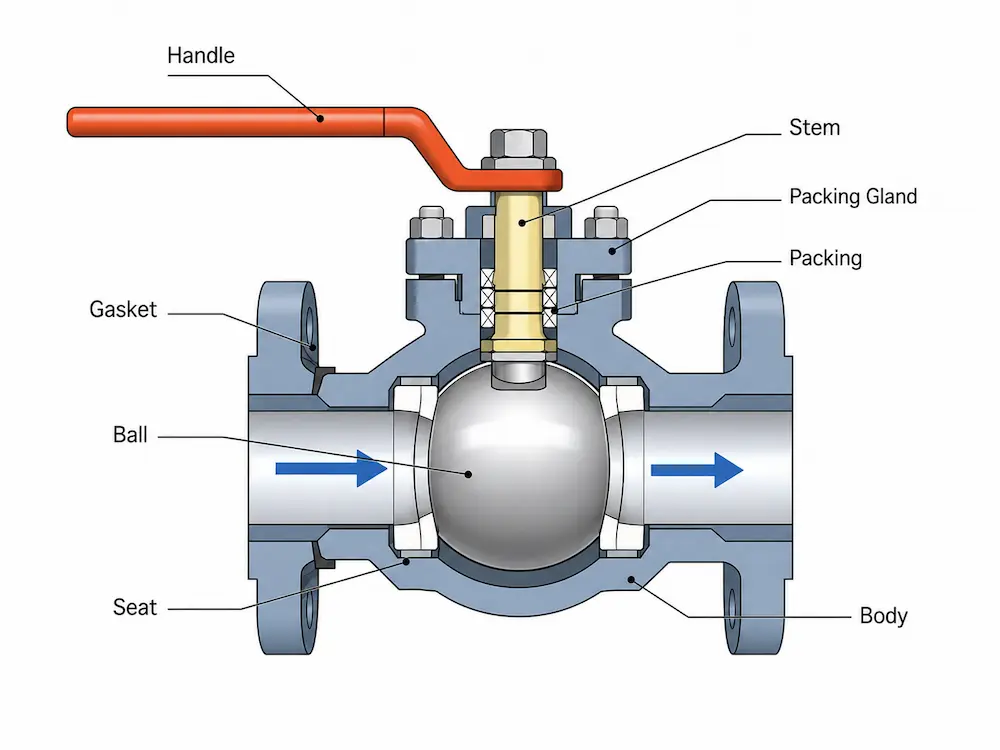
An industrial ball valve is a valve that uses a rotating ball with a bore through the center to control fluid flow. When the bore is aligned with the pipeline, the valve is open. When the ball rotates 90 degrees, the solid side of the ball blocks the flow path and the valve is closed.
Industrial ball valves are mainly used for on-off isolation, but certain designs may also support flow routing, switching, or limited control functions. They are commonly used in liquid, gas, vapor, chemical, water, oil, and industrial utility systems.
Ball valves are popular because they combine a simple operating principle with strong sealing performance and compact installation. However, different ball valve designs can perform very differently in real service. Buyers should not treat all ball valves as the same product.
How Does a Ball Valve Work?
A ball valve works by rotating a ball inside the valve body. The ball has a hole, called a bore or port, through its center. In the open position, the bore lines up with the pipe and allows media to pass through. In the closed position, the ball rotates 90 degrees and blocks the flow.
The sealing function usually depends on seats placed around the ball. These seats may be made from PTFE, reinforced PTFE, PEEK, metal, or other materials depending on pressure, temperature, media, and operating conditions.
Most ball valves are designed for quick shutoff rather than precise throttling. Using a standard ball valve for long-term partially open throttling may cause seat wear, vibration, erosion, or unstable flow. For accurate process control, a dedicated control valve may be more suitable.
For flow routing principles, port positions, and L-port or T-port operation, see our detailed guide on how a 3-way ball valve works.
Main Types of Industrial Ball Valves
Floating Ball Valves
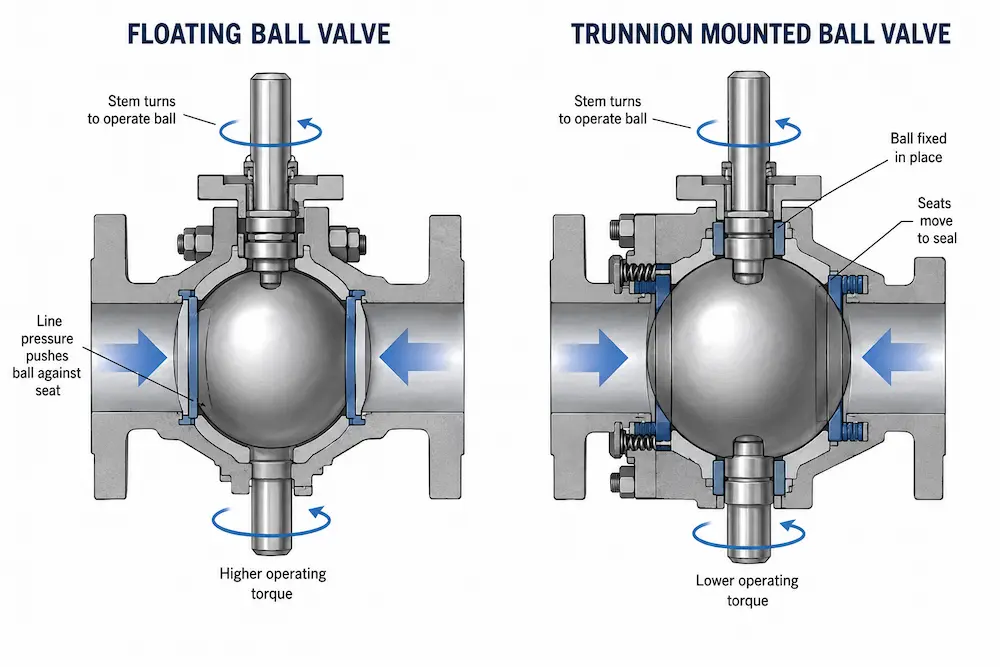
A floating ball valve uses a ball that is not fixed by a lower trunnion. The ball is held between seats and moves slightly downstream under pressure, helping the ball press against the downstream seat to form a seal.
Floating ball valves are common in small to medium sizes and many general industrial applications. They are often selected for water, gas, oil, chemical transfer, and general shutoff service where pressure, size, and torque remain within the valve design limits.
For standard pipeline isolation duties, buyers may evaluate a floating ball valve when compact structure, reliable shutoff, and practical cost-performance are important.
Trunnion Mounted Ball Valves
A trunnion mounted ball valve uses mechanical supports at the top and bottom of the ball. The ball is fixed in position, and the seats move toward the ball to create sealing force. This design is commonly used for larger sizes, higher pressures, and applications where operating torque must be controlled.
Trunnion mounted ball valves are often considered for oil and gas, pipeline transmission, high-pressure service, and large-diameter systems. They usually require more complex design and higher manufacturing cost than floating ball valves.
For a detailed comparison of ball support structure, sealing principle, pressure capability, and operating torque, read our guide on floating vs trunnion ball valve.
2-Way Ball Valves
A 2-way ball valve has one inlet and one outlet. It is the most common ball valve type and is mainly used for open-close isolation in pipelines.
2-way ball valves are suitable for chemical transfer, water lines, gas service, oil systems, tank inlet and outlet lines, and many industrial utility systems.
3-Way Ball Valves
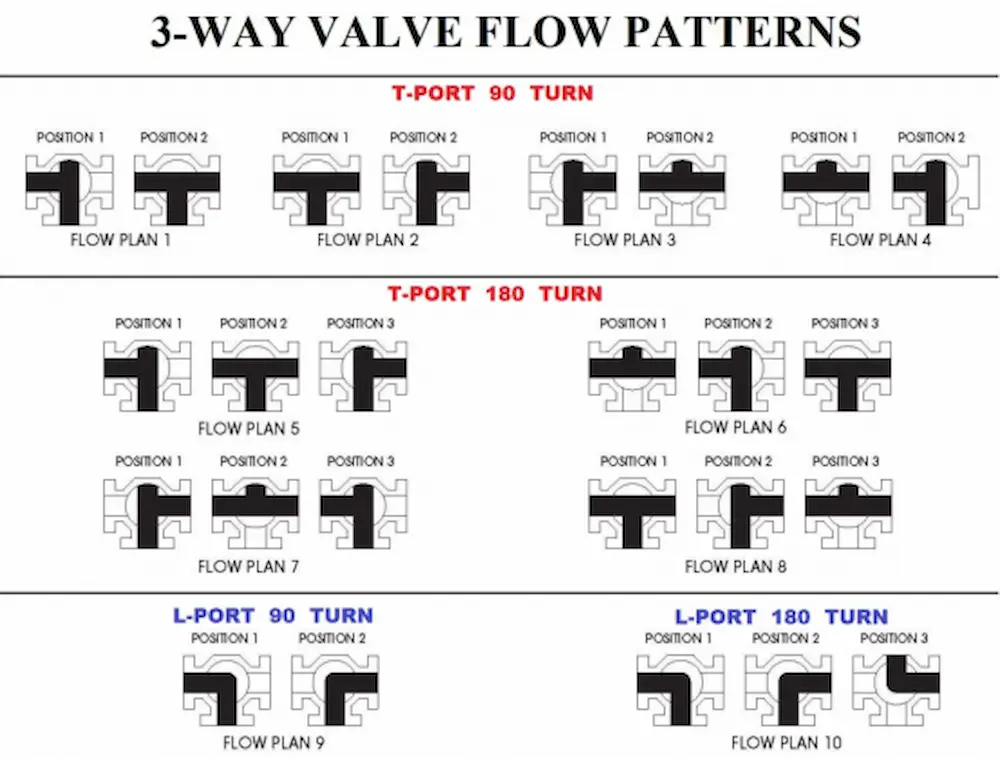
A 3-way ball valve has three ports and is used for flow diversion, mixing, bypass, or switching between lines. It may use an L-port or T-port ball depending on the flow logic required by the system.
3-way ball valves are useful when one valve needs to control multiple flow paths. For automated routing, buyers may consider an electric three-way ball valve where remote control and process switching are required.
If you are deciding between simple shutoff and multi-port routing, this guide on 2-way vs 3-way ball valve explains when to choose each structure.
Full Port Ball Valves
A full port ball valve has a bore size close to the pipeline inner diameter. It reduces pressure drop and allows easier flow passage. Full port valves are often selected when low flow restriction, pigging, cleaning, or high flow capacity is important.
Reduced Port Ball Valves
A reduced port ball valve has a smaller bore than the pipeline. It is usually more compact and cost-effective, but it creates higher pressure drop compared with a full port design. Reduced port valves are often acceptable when full flow capacity is not required.
For flow capacity, pressure drop, pigging, and bore size comparison, see our guide on full port vs reduced port ball valve.
Industrial Ball Valve Type Comparison
| Ball Valve Type | Best Use | Main Advantages | Selection Risk |
|---|---|---|---|
| Floating Ball Valve | General industrial shutoff | Compact, reliable, cost-effective in many sizes | Torque increases with pressure and size |
| Trunnion Ball Valve | Large size or high-pressure service | Lower operating torque, suitable for heavy-duty pipelines | Higher cost and more complex structure |
| 2-Way Ball Valve | Pipeline isolation | Simple flow path, fast operation | Not suitable for multi-line routing |
| 3-Way Ball Valve | Diversion, mixing, bypass, switching | Controls multiple flow paths with one valve | Port configuration must match process logic |
| Full Port Ball Valve | Low pressure drop and full flow | Higher flow capacity and easier cleaning | Larger body and higher cost |
| Reduced Port Ball Valve | General shutoff where pressure drop is acceptable | Compact and cost-effective | Lower flow capacity than full port design |
Common Ball Valve Body Materials
Stainless Steel Ball Valves
Stainless steel ball valves are widely used in chemical processing, water treatment, food and beverage, oil and gas, clean fluids, and corrosive industrial systems. Common grades include 304, 316, and 316L stainless steel.
316 and 316L stainless steel are often selected when better corrosion resistance is required compared with 304. However, stainless steel should not be treated as a universal solution. Strong acids, chloride-rich fluids, seawater, high-temperature corrosive media, or severe chemical mixtures may require lined valves, titanium, duplex stainless steel, or nickel alloys.
Buyers evaluating stainless steel performance in demanding systems can also read this guide on stainless steel valves for high-pressure applications.
For a deeper material-focused guide, read our article on stainless steel ball valves, including 304, 316, 316L, PTFE seats, corrosion resistance, and industrial applications.
Carbon Steel Ball Valves
Carbon steel ball valves are used in many oil, gas, steam, fuel, and general industrial services where corrosion risk is controlled and pressure or temperature requirements are higher. They may be suitable for non-corrosive or mildly corrosive media depending on coatings, trim, seat, and process conditions.
PTFE Ball Valves and PTFE-Seated Ball Valves
PTFE is commonly used in ball valve seats and seals because of its broad chemical resistance and low friction. PTFE-seated ball valves are often selected for clean chemical fluids, water treatment chemicals, food and beverage fluids, and corrosive media where the valve design is suitable.
For applications requiring PTFE seating and chemical-resistant sealing performance, buyers may evaluate a PTFE ball valve depending on media, pressure, temperature, and shutoff requirements.
Titanium Ball Valves
Titanium ball valves may be considered for severe corrosion conditions such as chloride-rich media, seawater, desalination, oxidizing chemicals, and selected chemical transfer applications. Titanium is usually more expensive than standard stainless steel, so it should be selected when corrosion resistance, service life, and failure risk justify the cost.
For severe corrosive service, buyers may compare a titanium ball valve when standard stainless steel is not sufficient.
Alloy Ball Valves
Duplex stainless steel, super duplex stainless steel, nickel alloys, and other special alloys may be used in high-risk chemical, offshore, seawater, acid, or high-pressure applications. Alloy selection should be based on media compatibility, project standards, temperature, pressure, and total cost of ownership.
Seat and Seal Materials for Ball Valves
Ball valve performance depends heavily on seat and seal materials. A correct body material cannot prevent leakage if the seat, O-ring, packing, or gasket is incompatible with the medium.
| Seat / Seal Material | Main Strengths | Limitations | Common Use |
|---|---|---|---|
| PTFE | Broad chemical resistance, low friction | Temperature, pressure, and abrasion limits must be checked | Chemical, water treatment, clean fluid service |
| Reinforced PTFE | Improved mechanical strength compared with standard PTFE | Compatibility depends on filler and service condition | Higher pressure or more demanding soft-seat service |
| PEEK | Higher strength and temperature capability in selected applications | Higher cost and compatibility review required | High-performance industrial ball valves |
| EPDM | Useful for water, some acids, and some alkalis | Not suitable for many oils and hydrocarbons | O-rings, seals, selected water and chemical service |
| FKM | Useful for many oils, fuels, and selected chemicals | Not universal for all acids and alkalis | O-rings and seals in selected industrial applications |
| Metal Seat | Suitable for high temperature, abrasion, or severe service | May require higher torque and special sealing design | High-temperature, abrasive, or severe-duty ball valves |
For chemical service, buyers should review seat and seal compatibility carefully. The same valve body can perform very differently depending on seat material, seal material, pressure, temperature, and media cleanliness.
Connection Types for Industrial Ball Valves
Flanged Ball Valves
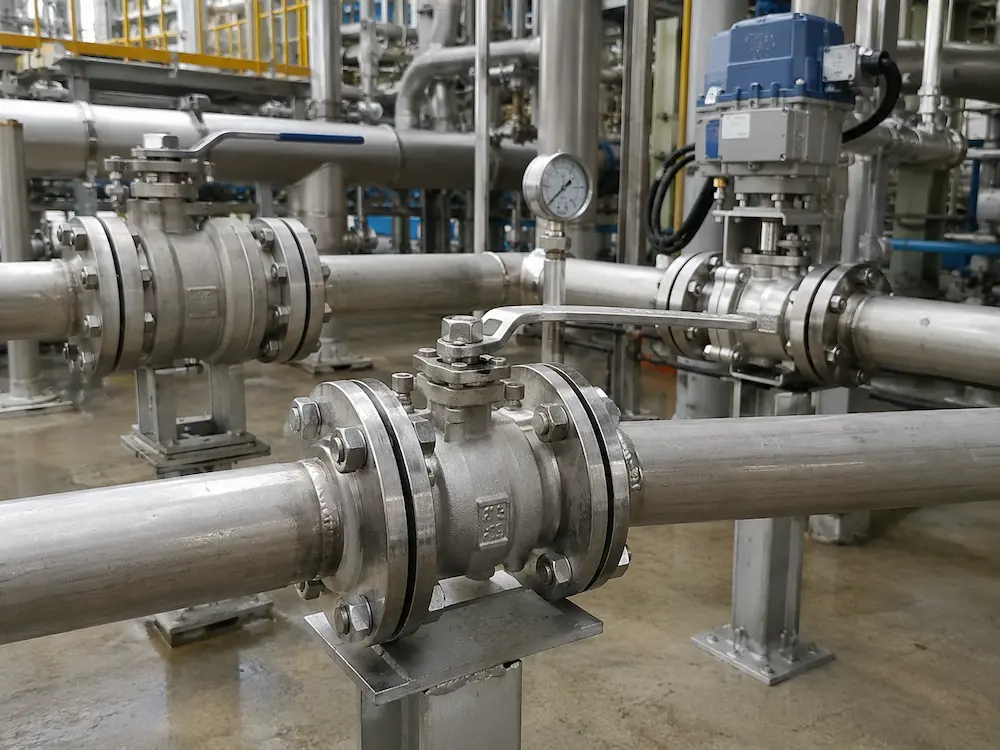
Flanged ball valves are widely used in industrial piping because they are easy to install, remove, inspect, and replace. They are common in chemical plants, oil and gas pipelines, water treatment systems, and power plant utilities.
Buyers should confirm flange standard, pressure class, face type, gasket material, bolt material, and installation space. For welded or flanged process lines, a flanged welded ball valve may be evaluated depending on project requirements.
Threaded Ball Valves
Threaded ball valves are common in smaller pipeline sizes and utility systems. They are compact and easy to install, but they may not be preferred for higher-risk chemical, high-pressure, or large-diameter services where flanged or welded connections are more suitable.
Welded Ball Valves
Welded ball valves are used where permanent, leak-tight piping connections are required. They are common in certain oil, gas, steam, and high-pressure services. Buyers should consider maintenance access because welded valves are harder to remove than flanged valves.
Manual, Electric, and Pneumatic Ball Valves
Manual Ball Valves
Manual ball valves are operated by a lever handle, handwheel, or gearbox. They are suitable for accessible pipelines, simple isolation duties, low-frequency operation, and cost-sensitive applications.
Electric Ball Valves
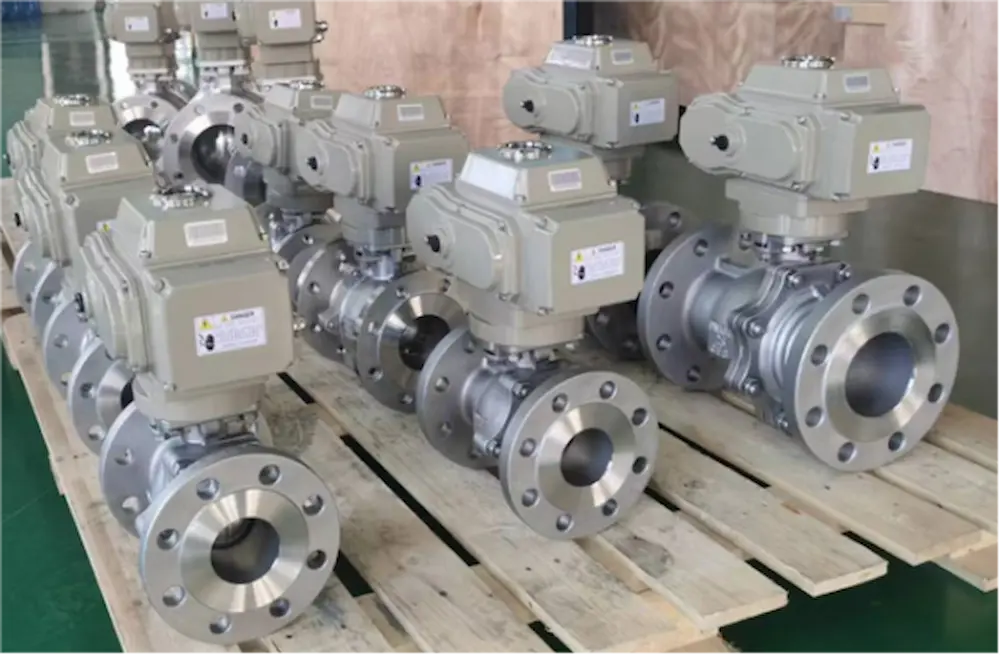
Electric ball valves use an electric actuator for automated open-close or modulating operation. They are useful for remote operation, batch control, tank transfer, chemical dosing, and process automation.
Buyers selecting electric actuated valves should confirm actuator torque, voltage, control signal, duty cycle, enclosure protection, manual override, and feedback signal. For chemical automation, read our guide on electric ball valves in chemical plants. For broader electric valve selection, see electric ball valves.
Pneumatic Ball Valves
Pneumatic ball valves use compressed air to operate the valve. They are common in process plants where fast operation, high cycling, fail-safe spring return, or hazardous area requirements are important. Pneumatic accessories may include solenoid valves, limit switches, positioners, filters, and regulators.
Where Industrial Ball Valves Are Used
For application-based selection by water, gas, steam, oil, chemical, food, and utility service, read our guide on ball valve applications.
Chemical Processing
Ball valves are used in chemical transfer, dosing, tank isolation, acid and alkali systems, solvent handling, water treatment chemicals, and process utilities. Material compatibility is critical because the body, seat, seal, and stem may all face chemical attack.
For chemical plant automation, actuator protection, corrosion resistance, and safety isolation, see our guide on electric ball valves in chemical plants.
Oil and Gas
Oil and gas systems use ball valves for isolation, pipeline shutoff, gas service, fuel handling, and process systems. Larger sizes and higher pressures may require trunnion mounted designs, special seats, fire-safe designs, or project-specific standards.
For gas-related applications, buyers can also read this article on ball valves for gases.
Water Treatment
Water and wastewater systems use ball valves for chemical dosing, filtration skids, pump isolation, distribution lines, and utility pipelines. Material choice depends on water quality, chemicals, pressure, and operation frequency.
Power Generation
Power plants use ball valves in water systems, fuel systems, chemical injection, auxiliary pipelines, and selected steam-related applications. High temperature and pressure should be reviewed carefully before selecting soft seats.
Food and Beverage
Stainless steel ball valves may be used in clean fluid handling where hygienic design, cleanability, and material compatibility are important. Buyers should confirm applicable standards and surface finish requirements.
Ball Valves vs Gate Valves and Globe Valves
Ball valves, gate valves, and globe valves are often compared because all three are common industrial valves. Ball valves are typically preferred for fast shutoff and low pressure drop. Gate valves are often used for full-bore isolation in larger pipelines. Globe valves are commonly used for throttling and flow regulation.
For a broader valve comparison, see our guide on ball valve vs gate valve vs globe valve.
| Valve Type | Main Function | Strength | Typical Limitation |
|---|---|---|---|
| Ball Valve | Fast shutoff and isolation | Quarter-turn operation, tight sealing, low pressure drop | Not ideal for precise throttling unless specially designed |
| Gate Valve | Full open or closed isolation | Good for large pipelines and low flow restriction | Slower operation and not for throttling |
| Globe Valve | Flow regulation | Better throttling capability | Higher pressure drop than ball or gate valves |
How to Choose the Right Industrial Ball Valve
Ball valve selection should begin with real working conditions. Buyers should avoid selecting only by size, connection, or price.
| Selection Item | What to Confirm | Why It Matters |
|---|---|---|
| Medium | Water, gas, oil, steam, chemical, slurry, solvent, etc. | Determines body, seat, seal, and trim material |
| Pressure | Operating pressure and design pressure | Determines pressure class and valve structure |
| Temperature | Normal, maximum, and cleaning temperature | Affects seat, seal, and body material selection |
| Valve Size | DN/NPS size and pipe schedule | Impacts flow capacity, torque, and connection |
| Port Type | Full port or reduced port | Controls pressure drop and flow capacity |
| Ball Design | Floating or trunnion mounted | Affects pressure capability and operating torque |
| Connection | Flanged, threaded, welded, or compact design | Must match pipeline design and maintenance needs |
| Operation | Manual, gearbox, electric, or pneumatic | Determines torque, automation, and control requirements |
| Documentation | Drawings, test reports, certificates, datasheets | Supports project approval and quality control |
Common Ball Valve Selection Mistakes
Mistake 1: Choosing Only by Price
The lowest-priced ball valve may fail early if body material, seat material, pressure rating, or operation method does not match the working condition.
Mistake 2: Ignoring Seat Material
Seat material directly affects leakage, torque, temperature capability, chemical resistance, and service life. Buyers should confirm whether PTFE, reinforced PTFE, PEEK, metal seat, EPDM, FKM, or other materials are suitable.
Mistake 3: Using Ball Valves for Precise Throttling Without Review
Standard ball valves are mainly designed for open-close service. Long-term throttling may damage seats or create unstable control unless the valve is specifically designed for modulating duty.
Mistake 4: Selecting Reduced Port When Full Flow Is Required
Reduced port valves may be cost-effective, but they create higher pressure drop and lower flow capacity. Buyers should confirm whether full port design is required.
Mistake 5: Undersizing the Actuator
For electric or pneumatic ball valves, actuator torque should be based on valve torque data and real service conditions. Deposits, seat swelling, corrosion, or long idle periods can increase torque over time.
Documentation and Quality Control
For industrial projects, buyers should request technical documents instead of relying only on product photos or short quotations. Useful documents may include:
- Valve datasheet
- Dimensional drawing
- Material certificate
- Pressure test report
- Seat leakage test report
- Seat and seal material confirmation
- Actuator datasheet if automated
- Installation and maintenance manual
- Packing and marking information
Related Deep-Dive Guides in This Ball Valve Series
This article is the main guide for industrial ball valve selection. For more detailed engineering and purchasing decisions, the following supporting guides explain specific ball valve structures, flow paths, materials, automation options, and application conditions.
- How Does a 3-Way Ball Valve Work? — explains L-port and T-port flow paths, diversion, mixing, bypass, and 3-way ball valve operating logic.
- 2-Way vs 3-Way Ball Valve: What Is the Difference? — compares simple shutoff ball valves with multi-port flow routing ball valves for industrial pipeline systems.
- Floating vs Trunnion Ball Valve: What’s the Difference? — compares ball support structure, sealing principle, torque, pressure capability, valve size, and application suitability.
- Full Port vs Reduced Port Ball Valve — explains bore size, flow capacity, pressure drop, pigging requirements, cost, and application differences.
- Electric Ball Valves Selection Guide — covers actuator torque, voltage, control signal, duty cycle, enclosure rating, feedback, and automation selection.
- Electric Ball Valves in Chemical Plants — focuses on chemical plant automation, corrosion resistance, actuator protection, safety isolation, and flow control.
- Stainless Steel Ball Valves for Industrial Applications — explains 304, 316, 316L, seat materials, corrosion resistance, pressure, temperature, and industrial applications.
- Ball Valve Applications: Water, Gas, Steam, Oil and Chemical Service — explains how ball valves are selected for different media and industrial pipeline applications.
Together, these guides form a complete industrial ball valve topic cluster covering valve structure, port design, materials, seats, automation, flow capacity, pressure drop, and application-based selection.
Final Recommendations for B2B Buyers
Industrial ball valves are reliable and versatile, but the right valve depends on the real operating condition. Buyers should confirm the medium, pressure, temperature, flow capacity, material compatibility, seat material, valve structure, connection type, operation method, and documentation requirements before placing an order.
For clean liquid and general shutoff, a floating ball valve may be suitable. For large size or high-pressure service, a trunnion mounted design may be required. For chemical service, stainless steel, PTFE seats, titanium, or special materials may be needed. For automation, actuator torque, voltage, control signal, and enclosure protection should be reviewed carefully.
If you need help selecting industrial ball valves for chemical processing, oil and gas, water treatment, gas service, steam, or general pipeline isolation, Vcore Valve can review your working conditions and recommend a suitable valve configuration. Buyers can also browse our industrial ball valve solutions and product range for available options.
For industrial sourcing, the best question is not simply “What size ball valve do I need?” The better question is: “Which ball valve structure, material, seat, connection, and operation method can work reliably in this exact pipeline service?”
FAQs
1. What are industrial ball valves used for?
Industrial ball valves are used for shutoff, isolation, flow routing, tank transfer, gas service, chemical handling, water treatment, oil systems, and automated pipeline control. They are commonly used where fast operation, tight sealing, and low pressure drop are important.
2. What is the difference between floating and trunnion ball valves?
A floating ball valve uses pressure to push the ball against the downstream seat, while a trunnion mounted ball valve supports the ball mechanically at the top and bottom. Floating ball valves are common in smaller and medium sizes, while trunnion ball valves are often used for larger sizes and higher pressures.
3. Are ball valves suitable for throttling?
Standard ball valves are mainly designed for open-close service. They can be used for limited control in some systems, but long-term throttling may cause seat wear, vibration, or unstable flow. For precise control, a globe valve or control valve may be more suitable.
4. Which material is best for industrial ball valves?
The best material depends on the medium, pressure, temperature, and corrosion risk. Stainless steel is widely used for many industrial services, PTFE seats are common for chemical resistance, titanium may be used for severe corrosion, and carbon steel may be suitable for selected oil, gas, steam, or non-corrosive services.
5. How do I choose the right ball valve?
To choose the right ball valve, confirm the medium, pressure, temperature, valve size, port type, body material, seat material, connection standard, operation method, actuator requirement, and documentation needs. The supplier can then recommend a suitable ball valve structure and material configuration.