A valve may pass a final pressure test and still arrive with unresolved documentation, traceability or dimensional issues. The purpose of a valve Inspection and Test Plan is to prevent those gaps by defining what will be checked, when it will be checked, who must be notified and what evidence must be retained.
For project orders, the ITP becomes a shared control document among the manufacturer, purchaser, EPC contractor and any appointed third-party inspector. It does not replace the purchase specification or applicable valve standards. Instead, it maps those requirements to manufacturing and inspection stages so that important checks are not left until shipment.
This guide explains the typical meaning of Hold, Witness, Review and Surveillance points, provides an illustrative valve ITP matrix and gives buyers a checklist for reviewing an ITP before production.
What Is a Valve Inspection and Test Plan?
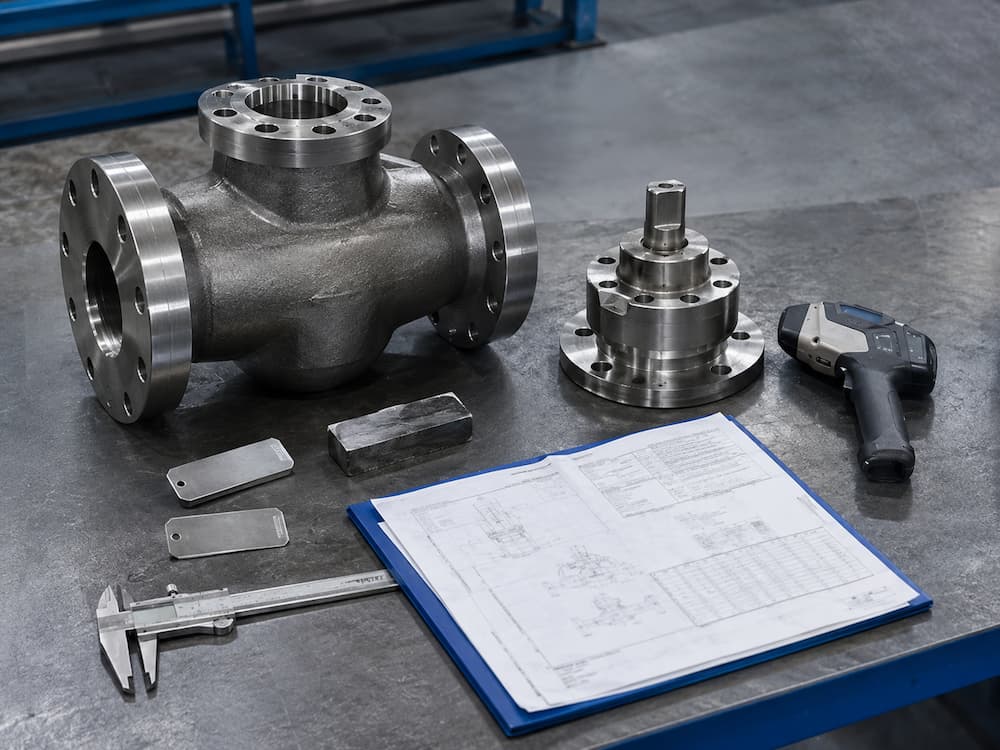
A valve Inspection and Test Plan, commonly abbreviated as ITP, is a stage-by-stage quality control document for a specific order, product scope or manufacturing process. It identifies the inspections, tests and document reviews needed to demonstrate conformity with the confirmed requirements.
A usable ITP normally connects each activity to:
- the applicable purchase order, specification, approved drawing, procedure or standard;
- a defined acceptance criterion;
- the manufacturer, purchaser, third-party or other responsible party;
- a Hold, Witness, Review or Surveillance designation where required;
- the inspection or test record that will provide objective evidence; and
- the release, sign-off or status needed before the next controlled stage.
The ITP should be specific enough to control the order. A generic form listing “material inspection,” “pressure test” and “final inspection” without references, acceptance criteria, responsibilities or records is only a checklist outline, not a complete project ITP.
Why the ITP Must Be Agreed Before Manufacturing
Many inspection activities cannot be reconstructed after the valve has been assembled, coated or packed. Heat-number transfer, examination of machined surfaces, verification before welding or overlay, and attendance at pressure testing are examples of controls that may depend on the production sequence.
Late ITP approval creates practical conflicts. The purchaser may request a Hold point after the relevant operation is complete, or the manufacturer may discover that a third-party witness requires notice that was never built into the schedule. Retesting, disassembly or duplicate document preparation may then be necessary.
Before production starts, the parties should therefore confirm:
- the approved ITP revision and its scope;
- the meaning of every point code used in the ITP legend;
- which organization has release authority at each Hold point;
- the notice period and communication route for Witness and Hold points;
- whether written waiver or non-attendance permits work to proceed;
- the required inspection records and final document format; and
- how changes, concessions and nonconformities will be controlled.
Hold, Witness, Review and Surveillance Points Explained
H, W, R and S are common ITP codes, but their exact contractual effect is not universal. The approved ITP legend, purchase specification and inspection procedure govern. The descriptions below are typical working meanings and should not be treated as a substitute for the project definitions.
| Code | Typical meaning | Can work proceed? | Typical valve example |
|---|---|---|---|
| H — Hold | A mandatory stop at a defined stage pending attendance, verification, release or documented waiver by the authorized party. | Normally no. The activity cannot pass the Hold point until the release condition in the approved ITP is met. | Release to pressure testing after test setup, identification and calibrated equipment have been verified, when the contract assigns this as a Hold point. |
| W — Witness | An inspection or test for which the designated party receives advance notice and has the opportunity to attend. | Possibly. Work may proceed after a documented waiver or under the agreed non-attendance rule, but only if the approved ITP allows it. | Witnessing shell or seat testing after the required notice has been issued. |
| R — Review | Review of a procedure, certificate, report, calculation, drawing or other quality record. | Depends on the ITP. A Review point is not automatically an approval or release point unless the document says so. | Reviewing material certificates, NDE reports, calibration records or a completed pressure test report. |
| S — Surveillance | Monitoring or intermittent observation of an activity, process or quality-control implementation. | Normally yes, unless a nonconformity or another contract provision requires work to stop. | Periodic observation of machining, assembly, coating preparation or identification controls. |
Key control: never assume that a Witness point automatically becomes a Hold point, or that missed attendance automatically authorizes production to continue. The written legend and release rules must answer those questions.
Hold Point
A Hold point protects an activity that should not become inaccessible or irreversible before the designated party verifies it. The ITP should state the party that releases the point and the evidence of release. Depending on the contract, that evidence might be a signed ITP row, an inspection release note, an approved record or a written waiver.
Hold points should be used selectively. Too many can disrupt production without improving control; too few can leave critical requirements unverified. The risk, service, valve design, project specification and ability to verify the result later should guide the decision.
Witness Point
A Witness point gives the named party an opportunity to attend an inspection or test. The manufacturer should send notice using the agreed channel and include enough information to identify the order, valve scope, activity, location, planned time and applicable ITP reference.
The notice period is contractual, not universal. If the purchaser or inspector cannot attend, the next step depends on the approved ITP: written waiver, rescheduling, remote witnessing or performance without attendance may be possible. That decision should be documented rather than assumed.
Review Point
A Review point applies to records rather than physical attendance alone. It may cover an approved drawing, welding procedure, material certificate, examination report, calibration certificate, test report, coating record or final data book index.
The ITP must show whether review is required before the activity, before release to the next stage or only as part of the final document package. A code “R” by itself does not establish timing or approval authority.
Surveillance Point
Surveillance is generally selective monitoring rather than continuous inspection. The purchaser or appointed inspector may observe the process, check implementation of approved procedures or sample records during manufacture. Surveillance does not transfer process-control responsibility away from the manufacturer.
If surveillance identifies a deviation, the response follows the purchase order, quality procedure and nonconformity process. Surveillance status alone does not determine disposition authority.
Who Does What in a Valve ITP?
The ITP should identify organizations by role and avoid ambiguous initials. Typical participants include:
- Manufacturer production: performs controlled manufacturing and provides access to the planned activity.
- Manufacturer quality control: verifies conformity, records results and controls internal release.
- Purchaser or EPC: defines project requirements, reviews agreed submittals and exercises designated inspection rights.
- Third-party inspector: performs the activities assigned by an appointment, inspection assignment or purchase requirement.
- Regulatory or other authorized body: participates only where the applicable legal or conformity-assessment framework requires it.
An appointed third-party inspector does not automatically have unlimited approval authority. The assignment should define what the inspector may witness, review, accept, reject or release, and which decisions remain with the purchaser or another authorized organization.
What Every Valve ITP Row Should Contain
A buyer should be able to read one row and understand the activity, the requirement and the evidence. Useful columns include:
- Stage or sequence: the production or documentation step.
- Inspection or test characteristic: exactly what will be checked.
- Method or procedure: how the check will be performed.
- Reference document: purchase specification, approved drawing, procedure or applicable standard.
- Acceptance criteria: the requirement that separates acceptance from rejection.
- Extent or frequency: each item, each heat, each batch, sampling plan or another defined basis.
- Responsible parties and point codes: manufacturer, purchaser, EPC, TPI or other party.
- Notification requirement: notice period and contact route where applicable.
- Record: certificate, report, checklist, photograph, test chart or release note.
- Status and sign-off: date, result, comments and authorized confirmation.
“As per standard” is usually too vague as an acceptance criterion when multiple standards, editions or project deviations may apply. The ITP should identify the controlled reference and, where useful, the relevant clause, drawing note or specification section.
Illustrative Valve ITP Matrix
The following matrix shows how typical valve manufacturing stages can be organized. It is an example only. It does not prescribe inspection points, test values, sampling or acceptance for a particular order. The actual ITP must be prepared from the confirmed valve design, purchase order, approved documents, applicable standards and project risk requirements.
| Stage | Typical activity | Acceptance basis | Possible point | Typical record |
|---|---|---|---|---|
| 1 | Purchase specification, datasheet, drawing and ITP review | Confirmed order requirements and approved document status | R or H, as specified | Approved submittal or review record |
| 2 | Incoming material identification and certificate review | Required material grade, component scope and traceability | R, W or H, as specified | MTC and incoming inspection record |
| 3 | Casting or forging visual examination and specified NDE | Approved procedure, project specification and applicable acceptance criteria | S, W or H, as specified | Examination and NDE reports |
| 4 | Machining and dimensional inspection | Approved drawing, tolerances and connection requirements | S, W or R, as specified | Dimensional report |
| 5 | Welding, overlay, heat treatment and related examination, if applicable | Approved procedures, personnel qualifications and project requirements | R, S, W or H, as specified | Procedure, qualification, heat-treatment and NDE records |
| 6 | Assembly, cleanliness, identification and operational check | Approved assembly requirements, drawing and datasheet | S or W, as specified | Assembly or in-process inspection record |
| 7 | Shell, seat and applicable backseat pressure testing | Purchase order and specified test standard, including confirmed pressure, duration, medium and leakage criteria | W or H, as specified | Pressure and leakage test report |
| 8 | Actuator and accessory functional tests, if supplied | Approved datasheets, diagrams, control philosophy and functional requirements | W, S or R, as specified | Functional test checklist and settings record |
| 9 | Coating, marking, nameplate and final visual inspection | Approved coating system, marking requirements and purchase documents | S, W or R, as specified | Coating and final inspection records |
| 10 | Document dossier, preservation, packing and shipment release | Approved document index, preservation specification and packing requirements | R or H, as specified | Final data book, packing record and release note |
Material and Traceability Controls in the ITP
Material control is more than collecting a certificate at the end of production. The ITP should define which valve components require certification, how heat or batch identity is maintained and at what stages identification is verified.
Where an order requires EN 10204 inspection documents, the document type and component scope should be fixed before material procurement. The difference between 3.1 and 3.2 documentation affects validation and inspection involvement; it should not be treated as a label that can simply be added after manufacture. See the related guide to EN 10204 3.1 vs 3.2 valve material certificates.
Typical traceability controls can include certificate-to-heat-number review, marking transfer during cutting or machining, component identification before assembly and reconciliation of completed records with the finished valve or batch. The required depth depends on the purchase specification and component criticality.
Pressure Testing as an ITP Stage
The ITP should not invent test requirements. It should point to the confirmed test standard and project specification, then identify the test method, scope, calibrated equipment, acceptance criteria, witness status and record.
For each applicable test, buyers should be able to determine:
- which valve or production lot is covered;
- whether shell, seat, backseat or another test applies;
- the specified pressure, duration, medium and leakage acceptance;
- the test direction and valve condition where relevant;
- the identification and valid status of measuring equipment;
- who must be notified or attend;
- what happens after a failed result or retest; and
- what data must appear in the final test record.
For more detail on shell, seat and leakage checks, use the valve pressure test methods guide. The test standard named in the final purchase documents remains the controlling reference.
ITP Controls for Actuated Valve Assemblies
When the order includes a pneumatic, electric or hydraulic actuator, the ITP should cover the complete assembled package where required—not only the bare valve. Applicable checks may include component identification, mounting orientation, coupling and alignment, full travel, direction of operation, position indication, fail action, local or manual override, signals, feedback and installed accessories.
The acceptance basis should come from the approved valve and actuator datasheets, sizing or torque documentation, wiring or pneumatic diagrams, accessory list and project control requirements. Actual tests must match the scope agreed for the order. The valve actuator selection guide explains the technical information that should be confirmed for an assembled package.
Notice, Attendance, Waiver and Release
An effective ITP separates four actions that are often confused:
- Notice: the manufacturer advises the named party that the inspection or test will be ready.
- Attendance: the named party observes or performs the assigned activity.
- Waiver: the party chooses not to attend or releases a requirement in the manner permitted by the contract.
- Release: the authorized party documents that the item may pass a controlled stage or proceed toward shipment.
The ITP or supporting inspection procedure should state the notice lead time, time-zone basis, working-day definition, recipients, required notice contents and rescheduling rules. It should also state whether silence after valid notice has any effect. Without an agreed rule, silence should not be treated as approval.
Remote witnessing may be acceptable for some projects, but the method should be agreed in advance. Camera coverage, valve identification, live instrument visibility, data retention and communication failures should be addressed before the test.
How Nonconformities and Retests Should Be Handled
An ITP records planned controls; it does not by itself resolve deviations. If an inspection or test result fails the acceptance criteria, the manufacturer should identify and control the affected item under the applicable nonconformity procedure.
The record should distinguish among correction, repair, rework, concession and rejection as defined by the project quality system. Any repair or deviation that requires purchaser approval should not be closed solely by an internal production decision.
Retesting should be traceable to the original failed result and the approved disposition. The final dossier should not present only the passing retest if the purchase requirements call for the nonconformity and disposition history to be included.
ITP vs QAP, FAT and Inspection Report
| Document or activity | Main purpose | Relationship to the ITP |
|---|---|---|
| Quality Assurance Plan (QAP) or project quality plan | Describes the broader quality system, organization, procedures and controls for the order or project. | The ITP translates relevant requirements into specific inspection and test stages. |
| Inspection and Test Plan (ITP) | Defines the sequence, checks, criteria, point codes, parties and records. | It is the control map for planned verification activities. |
| Factory Acceptance Test (FAT) | A defined acceptance event or test program performed before shipment, where required. | The ITP may identify FAT activities and their Hold or Witness status, but the FAT procedure contains the detailed test sequence. |
| Inspection or test report | Records actual results for a completed check or test. | It is objective evidence referenced by the relevant ITP row. |
| Inspection release note | Documents release within the authority assigned by the contract. | It may close a Hold point or support shipment release, but it does not replace all underlying records. |
For a broader explanation of document types, review valve certificates and quality documents.
Buyer Checklist for Reviewing a Valve ITP
Before approving the ITP, check the following items against the purchase order and technical specification:
- The ITP title, order reference, valve scope and revision are correct.
- All referenced standards, specifications, drawings and procedures use the agreed revisions.
- Acceptance criteria are measurable or linked to a controlled requirement.
- Inspection frequency and sampling are defined rather than implied.
- Material certificate type, component scope and traceability stages are stated.
- Any required NDE, heat treatment, hardness, PMI or special process control is included only where specified.
- Pressure and leakage tests match the applicable valve type and confirmed test standard.
- Actuator and accessory tests are included when the order covers an assembled package.
- The H/W/R/S legend and each party’s authority are unambiguous.
- Notice, waiver, release and rescheduling rules are documented.
- Measuring equipment and calibration status are addressed.
- Required reports, certificates and final dossier index are identified.
- Nonconformity, repair, concession and retest controls are linked to the applicable procedure.
- Preservation, packing, marking and shipment release are not omitted.
Common ITP Problems Buyers Should Reject or Clarify
- Undefined point codes: H, W, R and S appear in the table, but the legend does not state what they mean.
- No release authority: a Hold point exists, but no organization or signatory is responsible for releasing it.
- Vague acceptance: rows say “check” or “as required” without a controlled reference.
- Missing extent: the plan does not say whether inspection covers every valve, every heat, each batch or a sample.
- Final-only documentation: material and traceability records are scheduled for review only after the identity trail can no longer be verified.
- Uncontrolled revisions: the manufacturer and inspector are working from different ITP, drawing or datasheet revisions.
- Witness without notice rules: the plan requests attendance but does not define notice or non-attendance.
- Missing record names: there is no link between the performed activity and the final evidence.
Final Recommendations for Valve Buyers
A good valve ITP is not measured by the number of Hold or Witness points. It is measured by whether the plan controls the real order risks, links each check to an acceptance basis and leaves a traceable record.
Issue ITP requirements with the RFQ whenever inspection involvement, special documentation or third-party attendance is expected. Confirm the document before production, then manage notices and releases using the approved revision. For standard orders, the plan may be concise. For critical service, special materials or project-specific testing, it may require more detailed stages and records.
When requesting a quotation from Vcore Valve, provide the valve datasheet, applicable standards, required material documents, inspection point definitions, TPI scope and final dossier requirements. Inspection and documentation arrangements should be reviewed against the confirmed order before manufacturing begins.
Frequently Asked Questions
1. What is a valve Inspection and Test Plan?
A valve Inspection and Test Plan is a controlled document that lists manufacturing inspections, tests, reviews, acceptance criteria, responsible parties, point codes and required records for an order or defined product scope.
2. What is a Hold point in a valve ITP?
A Hold point is typically a mandatory stop. Work does not pass that stage until the authorized party completes the required verification and documents release or waiver according to the approved ITP and contract.
3. Can production continue if an inspector misses a Witness point?
Only under the agreed ITP rules. Some contracts allow work to proceed after valid notice, written waiver or expiration of a defined notice period; others require rescheduling or explicit release. Non-attendance should never be interpreted without checking the approved terms.
4. Is a Review point the same as document approval?
Not necessarily. A Review point identifies a record or document for review, but its timing, approval effect and release authority must be defined by the ITP or purchase documents.
5. Does third-party inspection replace the manufacturer’s quality control?
No. The manufacturer remains responsible for process control and conformity. A third-party inspector performs only the review, witness, surveillance or release activities assigned under the applicable inspection scope.
6. Should pressure testing always be a Hold point?
No universal rule makes every valve pressure test a Hold point. The purchaser should assign H, W or another status based on the project specification, risk, inspection strategy and contractual requirements.
7. When should the valve ITP be approved?
It should be approved before the controlled manufacturing and inspection activities begin. Material procurement, special processes, traceability and witness scheduling can be difficult or impossible to reconstruct after completion.
Technical References
- NSW Government — Quality Management Guidelines for Construction: general guidance on Hold and Witness points, surveillance and ITP control.
- NSW Government — Construction Procurement Guide: Contract Management: definitions and contract-management context for inspection opportunities, Hold points and Witness points.
- Austroads ATS 1120 — Quality Management Requirements: an official example of quality requirements covering ITPs, testing, records, traceability and surveillance.