Quick Summary: EN 10204 defines inspection documents for metallic products. For industrial valve orders, EN 10204 3.1 vs 3.2 certificates may be requested for specified castings, forgings, plate, bar or other metallic components. Both document types include results from specific inspection, but their validation arrangements differ. Type 3.1 is validated by the manufacturer’s authorized inspection representative who is independent of the manufacturing department. Type 3.2 also requires validation by the purchaser’s authorized inspection representative or an inspector designated by official regulations. Buyers should state the certificate type, component scope, material grade, traceability requirement and inspection arrangement before material procurement.
Industrial valve buyers often ask for an “MTC 3.1” or “3.2 certificate” without defining which valve components must be covered. This creates avoidable uncertainty during quotation and document approval. A supplier may understand the request as a certificate for the body material, while the purchaser expects certificates for the body, bonnet, end connectors, closure member, stem, bolting and other metallic parts.
The first distinction is therefore not only Type 3.1 versus Type 3.2. Buyers also need to define the material product, component scope, applicable material specification and traceability route. EN 10204 is an inspection-document standard for metallic products; it is not a design approval, pressure-test standard or complete certification of an assembled valve.
This guide explains how EN 10204 Type 3.1 and Type 3.2 documents relate to industrial valve purchasing, what each certificate can demonstrate, what it cannot demonstrate, and what should be checked before an order is released.
What Is EN 10204?
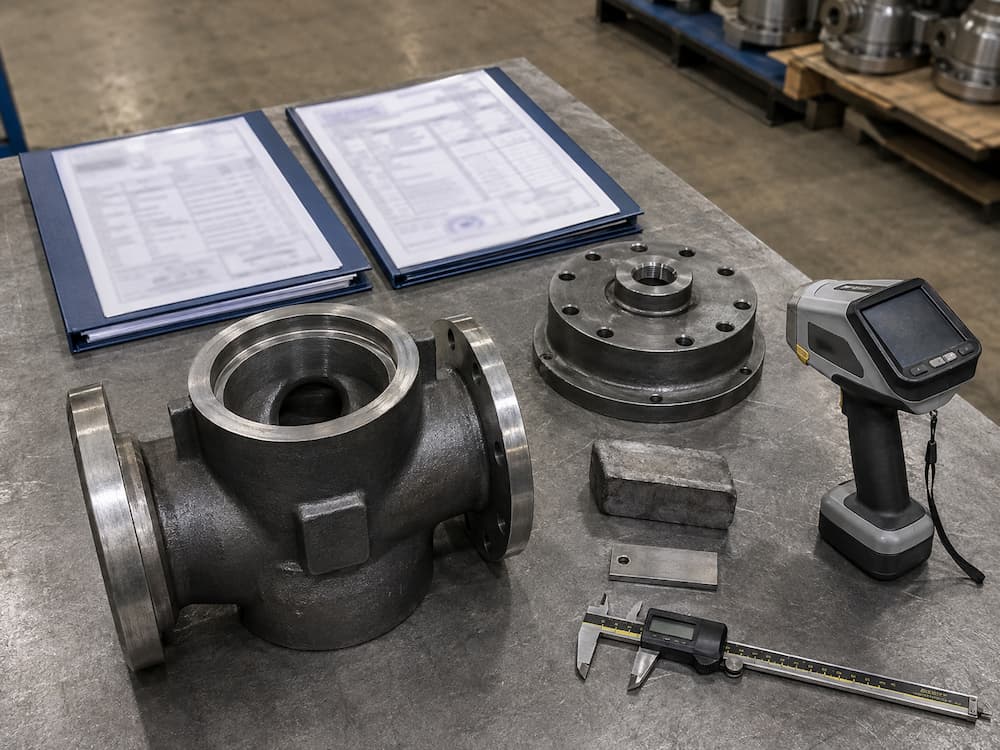
EN 10204 defines types of inspection documents supplied with metallic products. Its scope is relevant to products such as plate, sheet, bar, forgings and castings when the applicable product specification or purchase order requires an inspection document.
In an industrial valve supply chain, these metallic products may become valve bodies, bonnets, covers, end pieces, balls, wedges, discs, stems, shafts, seat rings, bolting or other components. The original inspection certificate is commonly issued by the material manufacturer or mill. The valve manufacturer or supplier then connects that document to the applicable component through material identification and traceability records.
The terms Material Test Certificate, Mill Test Certificate and MTC are commonly used in purchasing. However, the purchase order should identify the required EN 10204 document type instead of relying on the abbreviation “MTC” alone.
For an overview of other documents used with valve orders—including pressure-test reports, inspection records, datasheets, drawings and certificates of conformity—see our Valve Certificates and Quality Documents Guide.
EN 10204 Inspection Document Types
EN 10204 includes four principal document types. Type 3.1 and Type 3.2 are normally the main focus in project valve purchasing because they report results from specific inspection. Type 2.1 and Type 2.2 provide a different level of documented information.
| Document Type | General Content | Inspection Basis | Validation |
|---|---|---|---|
| Type 2.1 | Declaration that the supplied products comply with the order, without test results | No test results reported in the document | Manufacturer |
| Type 2.2 | Declaration of compliance with results from non-specific inspection | Results are not necessarily taken from the delivered product or its specific inspection unit | Manufacturer |
| Type 3.1 | Declaration of compliance with results from specific inspection | Specific inspection defined by the applicable product specification, order or agreed requirements | Manufacturer’s authorized inspection representative independent of the manufacturing department |
| Type 3.2 | Declaration of compliance with results from specific inspection | Specific inspection with the agreed independent validation arrangement | Manufacturer’s authorized inspection representative plus the purchaser’s authorized inspection representative or an inspector designated by official regulations |
The exact tests, sampling method and acceptance criteria do not come from the certificate number alone. They depend on the material specification, technical delivery condition, purchase order and any additional project requirements. A Type 3.1 certificate for ASTM A105 forging and a Type 3.1 certificate for ASTM A182 F51 forging will therefore contain different material requirements and test results.
What Is an EN 10204 Type 3.1 Certificate?
A Type 3.1 inspection certificate declares that the supplied metallic product complies with the order and provides results from specific inspection. The document is validated by an authorized inspection representative of the manufacturer who is independent of the manufacturing department.
“Independent of the manufacturing department” is important. Type 3.1 does not simply mean that any production employee can sign a material report. The validation must follow the manufacturer’s controlled inspection and quality system.
For valve components, a Type 3.1 document may include information such as:
- Material manufacturer and manufacturing location
- Certificate number and issue or revision status
- Purchaser, order or delivery reference where applicable
- Product form, dimensions, quantity or weight
- Material designation and applicable specification
- Heat, cast, melt, batch or inspection-lot identification
- Chemical composition results
- Mechanical-property results
- Heat-treatment condition where applicable
- Impact, hardness, corrosion or supplementary test results when required
- Statement of compliance and authorized validation
Not every certificate contains every item in this list. The required content depends on the material specification and order. A buyer should review the document against the actual purchase requirement rather than accept it because “3.1” appears in the title.
What Is an EN 10204 Type 3.2 Certificate?
Type 3.2 also declares compliance and reports specific inspection results, but it adds a second validation party. In addition to the manufacturer’s authorized inspection representative, the document is validated by either the purchaser’s authorized inspection representative or an inspector designated by official regulations.
In international valve projects, an independent inspection organization may perform this role when it has been appointed under the order or project inspection arrangement. However, “third-party signed 3.1” is not a sufficient specification. The purchaser should define who will perform the independent inspection, what activities must be reviewed or witnessed, what notification period applies, and which records must be included in the final document package.
Type 3.2 should therefore be arranged before material procurement and testing. If the supplied material only has Type 3.1 documentation, it should not automatically be represented as Type 3.2 merely by adding a later stamp. Any retrospective or “intent-of” verification route must be assessed and accepted by the appointed inspection body and purchaser against the project requirements.
EN 10204 Type 3.1 vs Type 3.2: Direct Comparison
| Buyer Check | Type 3.1 | Type 3.2 |
|---|---|---|
| Compliance statement | Included | Included |
| Specific inspection results | Included | Included |
| Manufacturer validation | Authorized representative independent of manufacturing | Authorized representative independent of manufacturing |
| Additional validation | Not part of the Type 3.1 definition | Purchaser’s authorized representative or inspector designated by official regulations |
| Common project arrangement | Material manufacturer’s controlled inspection and certificate release | Material manufacturer plus purchaser-appointed or officially designated inspection involvement |
| Planning requirement | State the certificate requirement before material is ordered | State certificate, inspector, scope, notification and witnessing requirements before material is ordered |
| Does it certify the assembled valve? | No | No |
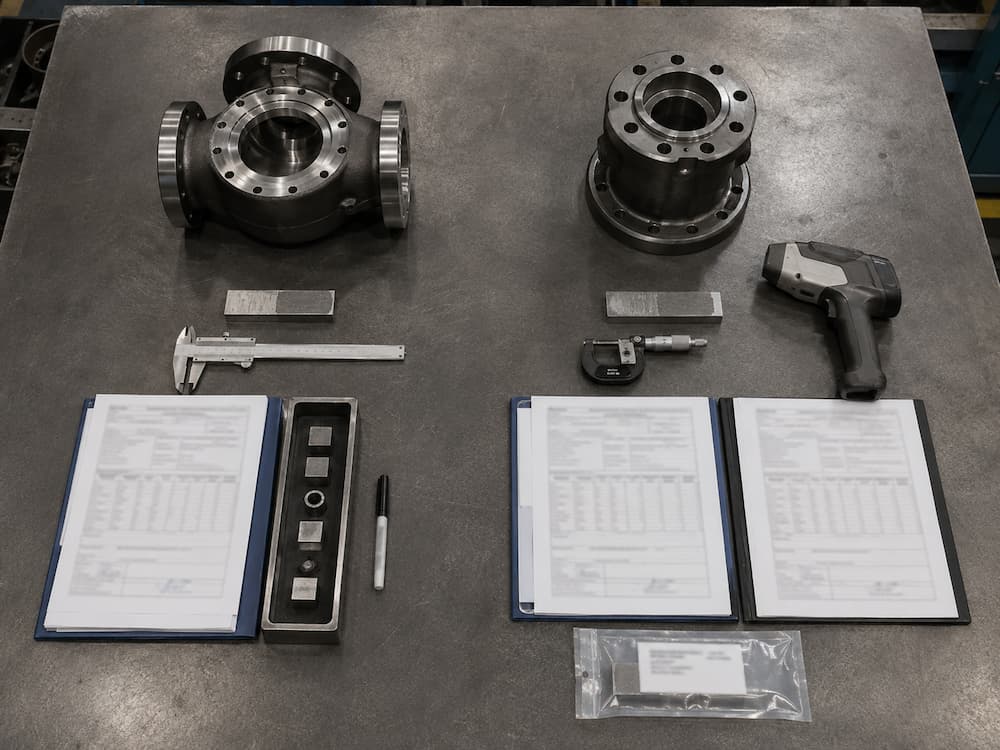
Which Valve Components Need Material Certificates?
EN 10204 does not create one universal component list for every valve. The purchaser, applicable valve standard, material specification and project documentation requirement determine the scope.
Depending on the valve type and project, buyers may request material certificates for:
- Body and bonnet or cover
- End connectors, body closures or pressure-containing end pieces
- Ball, wedge, disc, plug or other closure member
- Stem or shaft
- Seat rings and metallic trim
- Pressure-boundary bolting
- Welding consumables or weld-overlay materials when separately specified
A vague request such as “all certificates required” is difficult to price and may create a dispute after production. A clearer requirement is: “EN 10204 Type 3.1 inspection certificates required for body, bonnet and pressure-containing end connectors, with heat-number traceability to component marking and final material summary.” The exact wording should, of course, follow the project specification.
Material grade selection remains a separate engineering decision. Buyers comparing carbon steel, stainless steel, alloy steel, duplex or lined constructions should first use the Valve Material Selection Guide, then define the inspection-document requirement for the selected metallic components.
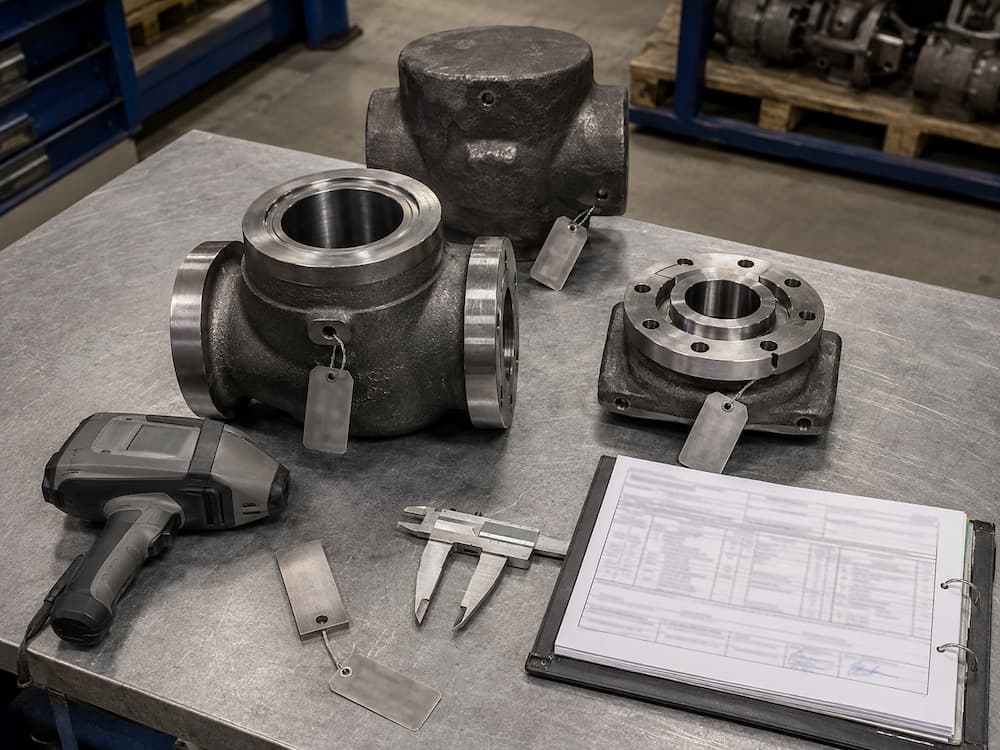
How Heat-Number Traceability Works for Valve Components
A material certificate has limited value if it cannot be connected to the supplied valve component. Traceability is the documented link between the material heat or inspection lot, the certificate, the manufactured component and the finished valve.
A typical traceability path may be:
- The material manufacturer assigns a heat, cast or batch identification.
- The inspection document records that identification and the applicable test results.
- The casting, forging, bar or plate is physically identified or controlled through a traceability procedure.
- The identification is transferred or maintained during cutting, machining and assembly.
- The valve manufacturer records which heat or batch was used for each controlled component or valve serial number.
- The final material summary and certificates are compiled into the order documentation package.
The marking method varies with component size, material, manufacturing stage and project procedure. Physical stamping, low-stress marking, tags, paint marking, traveler cards, material maps or electronic production records may be used where appropriate. The buyer should confirm both the required traceability level and any restrictions on marking critical components.
How Buyers Should Review a Valve MTC
Reviewing only the certificate heading is not enough. A useful material-certificate review connects the document to the purchase order, component and applicable specification.
| Review Item | What to Verify | Typical Problem |
|---|---|---|
| Document type | Type 3.1 or Type 3.2 matches the purchase order | A generic test report is supplied instead of the specified inspection certificate |
| Material identity | Grade, product form and specification match the approved valve bill of materials | Forged and cast grade designations are mixed or substituted |
| Component scope | The certificate covers the body, bonnet or other part required by the order | A valid certificate is supplied for the wrong component |
| Heat or batch number | Certificate identification matches the component and traceability record | The certificate cannot be linked to the finished valve |
| Chemical composition | Reported values and specified limits are reviewed against the applicable material requirement | Only the material name is checked |
| Mechanical properties | Tensile, yield, elongation, hardness, impact or other required results are present and acceptable | Required impact testing or heat-treatment evidence is missing |
| Supplementary requirements | PMI, corrosion tests, NDE, heat treatment or other project requirements are documented separately or referenced | The buyer assumes Type 3.1 automatically includes every supplementary test |
| Validation | Authorized signatory and Type 3.2 independent validation arrangement are consistent with the requirement | An unexplained stamp is treated as sufficient evidence |
| Document control | Certificate number, date, revision, page completeness and attachments are consistent | Pages are missing or multiple heats are combined without a clear index |
For forged valve materials such as A105, LF2, F304, F316, F51, F53, F11 and F22, our Forged Valve Materials Guide provides additional material-selection and certificate-review context.
What EN 10204 Type 3.1 and 3.2 Do Not Prove
A valid material inspection certificate is important, but it does not replace the other technical and quality documents required for an industrial valve.
Type 3.1 or Type 3.2 does not, by itself, prove:
- That the assembled valve complies with a particular valve design standard
- That the valve pressure class is suitable for the actual design temperature
- That shell, seat, backseat or fugitive-emission testing has been completed
- That the valve meets API, fire-safe, NACE, SIL, PED or other project requirements
- That the selected material is compatible with the process medium
- That every valve component is covered by the same certificate
- That an independent inspector witnessed every manufacturing and testing activity
An EN 10204 certificate documents inspection results, while positive material identification verifies selected alloying elements on the actual tested component. See our valve PMI testing guide for component scope, XRF and OES limitations, acceptance and reporting.
Pressure and leakage testing should be documented under the applicable valve test standard or approved project procedure. For the difference between shell, seat and backseat testing, see our Valve Pressure Test Methods Guide.
When Should Buyers Request Type 3.1 or Type 3.2?
The certificate type should come from the purchaser’s specification, applicable code, regulatory requirement or approved quality plan. A supplier should not replace Type 3.2 with Type 3.1 based only on cost or availability, and a buyer should not request Type 3.2 without considering the required inspection arrangement.
Type 3.1 may be specified when the project accepts manufacturer-controlled specific inspection and validation. Type 3.2 may be specified when purchaser or officially designated inspection validation is required. The decision depends on the contractual and regulatory context, not simply on whether the valve is “high pressure” or “critical.”
Before requesting Type 3.2, confirm:
- Who is authorized to perform the additional validation
- Which material products and valve components are included
- Which inspections or tests must be reviewed or witnessed
- What sampling and acceptance requirements apply
- How much advance notice the inspector requires
- Whether inspection, laboratory and travel costs are included
- Which documents are required for final release
Common Procurement Mistakes
1. Writing Only “MTC Required”
MTC does not define Type 2.2, 3.1 or 3.2, and it does not identify the component scope. State the required document type and covered components.
2. Requesting Type 3.2 After Production
Type 3.2 requires a defined validation arrangement. Requesting it after material testing or valve completion may make the original requirement impossible to reproduce. Confirm it before material procurement.
3. Treating an MTC as a Valve Pressure-Test Report
An MTC reports material-related information. Shell and seat tests belong in separate valve test records.
4. Checking the Material Grade but Not the Heat Number
A certificate for the correct grade is not enough if it cannot be traced to the supplied component.
5. Assuming Type 3.2 Defines the Complete Witness Scope
The inspection certificate type does not replace an Inspection and Test Plan. Hold points, witness points, document-review points and notification requirements should be defined separately.
6. Adding Documentation Requirements After Quotation
Special certificate types, supplementary testing, third-party inspection and traceability requirements can affect material availability, cost and delivery time. They should be included in the inquiry.
EN 10204 Requirements to Include in a Valve RFQ
A practical RFQ should provide enough detail for the supplier to confirm availability and price the documentation scope correctly.
- Valve type, size, pressure class and quantity
- Body, bonnet and other specified component materials
- Applicable ASTM, EN, ASME or project material specification
- Required EN 10204 document type: 3.1 or 3.2
- Exact components requiring inspection certificates
- Heat-number, batch or serial-number traceability requirement
- Required impact, hardness, PMI, corrosion, NDE or supplementary testing
- Third-party or purchaser inspection organization where Type 3.2 applies
- Required witness, hold, review and notification points
- Document language, electronic format, index and submission schedule
- Final material summary or manufacturing record book requirement
Vcore Valve can review the required material-document scope as part of a project inquiry. Final certificate availability must be confirmed against the selected material source, valve configuration, purchase-order requirements and agreed inspection plan. Send the valve list, material specifications, required certificate type and third-party inspection requirements before quotation so the documentation scope can be evaluated with the valve supply.
Buyer Decision Summary
EN 10204 Type 3.1 and Type 3.2 are inspection certificates for metallic products, not complete certificates for an assembled industrial valve. Both include results from specific inspection. Type 3.1 is validated by the manufacturer’s authorized inspection representative independent of manufacturing; Type 3.2 adds validation by the purchaser’s authorized representative or an inspector designated by official regulations.
For a reliable valve order, specify the certificate type, component scope, material grade, applicable specification, heat-number traceability, supplementary tests and inspection arrangement before production. Then review the MTC together with the valve datasheet, material list, inspection report, pressure-test record and final document index.
Technical References
- BSI — BS EN 10204:2004, Metallic Products: Types of Inspection Documents
- LRQA — EN 10204:2004 Type 3.2 Certification Services
Frequently Asked Questions
What is an EN 10204 Type 3.1 certificate for a valve?
For a valve order, a Type 3.1 certificate normally relates to specified metallic material products used for controlled valve components. It declares compliance with the order, reports specific inspection results and is validated by the material manufacturer’s authorized inspection representative who is independent of manufacturing.
What is the main difference between EN 10204 Type 3.1 and Type 3.2?
Both document types include specific inspection results. Type 3.1 is validated by the manufacturer’s authorized inspection representative independent of manufacturing. Type 3.2 also requires validation by the purchaser’s authorized inspection representative or an inspector designated by official regulations.
Does a Type 3.2 certificate mean every test was witnessed by a third party?
Not automatically. The inspection and witnessing scope must be defined by the purchase order, applicable specification and agreed inspection plan. Type 3.2 requires the specified additional validation, but buyers should separately identify the activities to be witnessed or reviewed.
Can a Type 3.1 certificate be converted into Type 3.2 after production?
It should not be assumed. Type 3.2 requires an agreed independent validation arrangement and supporting evidence. Any retrospective or “intent-of” verification must be assessed and accepted by the appointed inspection body and purchaser. The safest approach is to specify Type 3.2 before material procurement and testing.
Does an EN 10204 certificate replace a valve pressure-test report?
No. EN 10204 inspection certificates address metallic product documentation. Valve shell, seat, backseat and leakage testing require separate test records under the applicable valve test standard or project procedure.
What should a buyer check on a valve material certificate?
Check the document type, material grade, product form, applicable specification, component scope, heat or batch number, chemical composition, mechanical properties, required supplementary tests, validation, document revision and traceability to the supplied valve component.